
The right spring solution starts with the application, not the spring type
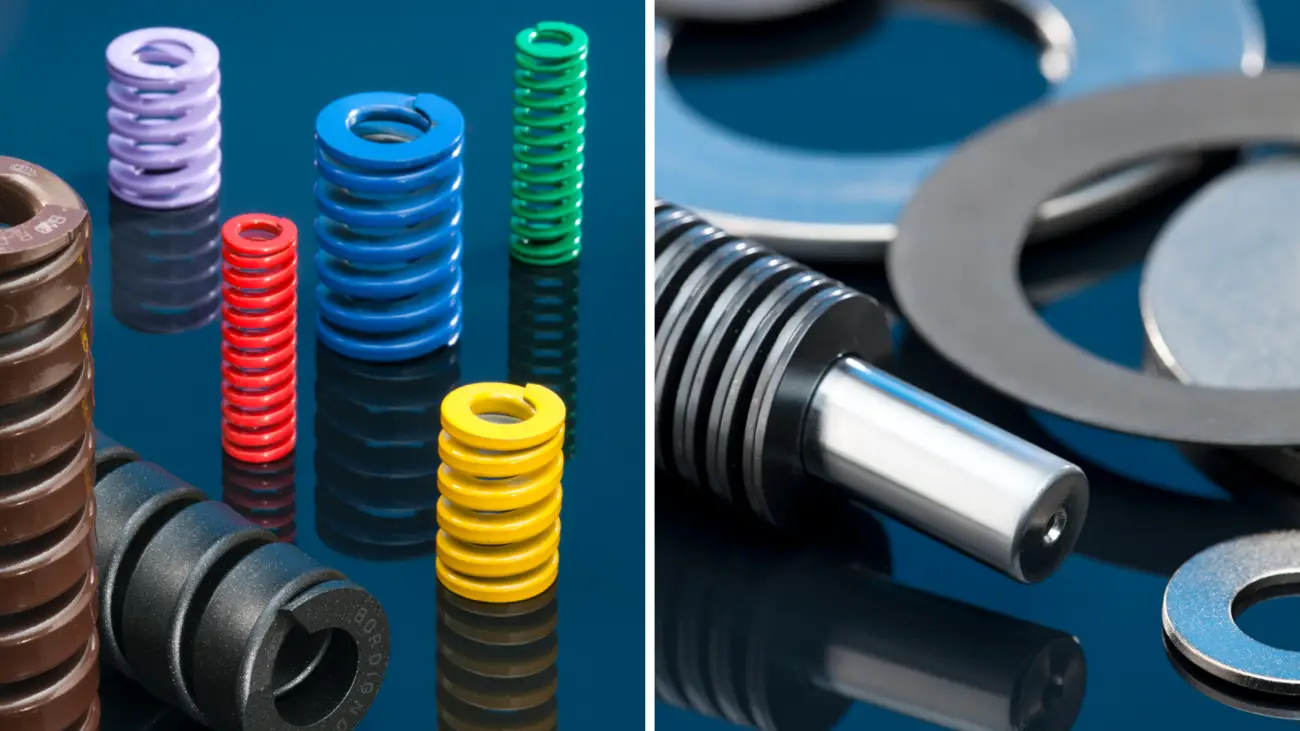
An off-the-shelf standard spring does not always meet the requirements of an application. Die springs and disc springs, in particular, can be customized in terms of dimensions, spring force, material and surface treatment. In this article, we explain when customization makes sense and how a standard spring can be optimized to better suit your application.
When a component or product needs a spring, the starting point is a specific function: providing force, enabling movement, returning a component to its original position, holding something in place or absorbing shocks.
An off-the-shelf standard spring may meet these needs, but not always. In that case, a customized standard spring can be a good alternative, bridging the gap between a stock product and a fully custom-designed spring. At Meconet, this approach is used particularly for die springs and disc springs. The solution starts with an existing spring design that is practical to manufacture. Its dimensions, material or other properties are then optimized for the application.
Not everything needs to be designed from scratch. The key is to understand what the spring needs to do, says Pasi Suvela, an experienced spring expert at Meconet.
When is a standard spring enough, and when should it be customized?
A standard spring is often a good choice when its dimensions, spring force, travel and other properties meet the application requirements without compromise. Customization is worth considering when installation space is limited, a precisely defined force or movement is required, or using a standard spring would mean changing the surrounding equipment design.
Operating conditions can also be decisive. Continuous dynamic loading, a high number of load cycles, temperature, moisture or corrosion may impose requirements that an off-the-shelf spring cannot meet as effectively as needed.
The question then becomes: why design the rest of the equipment around a standard spring when the spring itself can be adapted to the equipment?
Start with the function, not the spring type
Designers do not need to know in advance which type of spring an application requires. The starting point could be a specified force over a particular travel distance, or a need to provide return or compression force, hold a part in place, control vibration or limit movement. Once the functional requirements are clear, we can work together to find the right spring solution.
We do not need finished drawings. We just need to understand the required function and the constraints of the application.
Pasi Suvela, Spring Expert at Meconet
When a solution can be based on an existing standard spring, it is usually a die spring or a disc spring. Its dimensions, spring force, material, surface treatment or other properties can be adapted to the application.
Compression springs, extension springs, torsion springs and wire forms, on the other hand, are typically designed specifically for the customer.
There is no need to decide in advance whether the answer is an off-the-shelf standard spring, a customized standard spring or an entirely new spring design. The choice depends on what the spring must do and the conditions in which it must operate.
What can be customized in a standard spring?
Customizing a standard spring means much more than making it a few millimetres shorter or longer.
Depending on the application, the following characteristics of die springs and disc springs can be adapted:
- dimensions and geometry
- spring force and spring rate
- spring travel
- preload
- material
- surface treatment
- combining multiple springs into a spring assembly
By considering these characteristics together, the spring can be designed to perform its function as efficiently as possible within the available space.
Example: Customizing ISO 10243 die springs
An unpainted ISO 10243 die spring can be a good option when the spring comes into contact with hydraulic oil or another process fluid. Paint or other coating must not peel off the surface, enter the fluid circuit and compromise system cleanliness or operational reliability.
However, simply removing the paint is not enough. The spring material, surface finish, corrosion protection and operating conditions must also be assessed as a whole.
Example: Adapting a DIN 2093 disc spring to the application
A DIN 2093 disc spring can be customized through its dimensions, material and the way individual springs are combined. Arranging disc springs in series increases travel, while stacking them in parallel increases spring force. This allows the spring solution to be matched closely to the required force, movement and available space.
Material is part of spring performance
The spring material has a major influence on its function, service life, corrosion resistance and temperature resistance. It can also affect spring force and relaxation. Two springs with the same geometry but different materials may therefore perform differently in practice.
Changing the material can also change the spring’s mechanical properties. For example, a stainless steel spring may have different force characteristics from an equivalent spring made of conventional spring steel. Material selection and dimensioning should therefore be considered together.
In high temperatures or corrosive environments, conventional spring steel may not be the best choice. Stainless steel or a special high-temperature alloy may be needed instead. The material must always be selected for the conditions in which the spring will operate.
Pasi Suvela, Spring Expert at Meconet
Surface treatment can also influence the spring’s properties and durability in its operating environment. This is why material, surface treatment, geometry and loading should be considered together.
Spring service life can be considered from the design stage
How long does the spring need to last?
This question should be asked before the spring is designed, not only when the first version is tested. Service life can be assessed, for example, on the basis of the required number of load cycles. In addition to dimensions and material selection, manufacturing methods and post-treatments can also influence service life.
When loading, movement, operating environment and target number of cycles are known early enough, the spring can be dimensioned accordingly. This is particularly important in applications exposed to continuous dynamic loading.
The aim is not to manufacture a spring and then find out how long it lasts. Service life is one of the requirements that guide the design of the spring solution.
The greatest benefit of a customized spring may lie in the surrounding design
The unit price of a spring rarely tells the whole story of the cost of a solution. A spring optimized for its application may make it possible to eliminate other components, reduce equipment size, simplify assembly, reduce maintenance needs or improve reliability and service life. That is why the spring solution should be evaluated as part of the equipment’s overall design and total cost.
A spring that differs slightly from the standard version can be a sensible choice if it eliminates the need for a separate adapter or allows the surrounding structure to be simplified.
Pasi Suvela, Spring Expert at Meconet
Optimizing the spring may therefore deliver the greatest savings not in the spring itself, but elsewhere in the equipment.
Involve a spring expert early in the design process
The earlier spring functionality is considered in the design process, the more options are available. If the surrounding structure is already finalized and only a tightly defined space has been left for the spring, the options will naturally be more limited.
The design process can begin with a few essential questions:
- What must the spring do?
- How much force and travel are needed?
- How much space is available, and what conditions must it withstand?
- What service life is required?
These answers help determine the appropriate spring type, geometry, material and manufacturing method. The final solution may be an off-the-shelf standard spring, a standard spring customized for the application or a fully custom-designed spring.
Special requirements for a die spring?
When the dimensions, loading, operating environment and surface requirements are known, it is possible to find a solution even for needs that differ from the standard options.
Need a disc spring for demanding conditions?
If a standard product is not sufficient, the properties of a DIN 2093 disc spring can be adapted to the application through dimensions and material selection, for example.
Contact us and tell us what the spring needs to do in your application. We will be happy to help!

-
 Blog
BlogThe right way to overcome the most common challenge in spring design
Explore the topic -
 Guide
GuideDownload spring design tips
Explore the guide
Our experts are here to help
By involving us early in the design process, you allow us to support you in the best possible way. You can also contact us at any stage. We are happy to help.

You might also be interested in
-
 Blog
BlogThe right spring solution starts with the application, not the spring type
Explore the topic -
 News
NewsMeconet is Subcontractor of the Year 2026
Read the news -
 Fairs
FairsMore flexibility. Less complexity.
Read the news